If you’re carb sensitive or have any insulin-related concerns, consult your physician before starting. Also, if you feel foggy without carbs, start with the 48-hour protocol. I usually have a small breakfast around 10 am to hold me over until lunch at 1 or 2 pm. Suddenly, I wasn’t thinking about food, and sometimes I wouldn’t remember to eat anything until noon — and wasn’t hungry after that for hours. Working Against Gravity provides personalized macro coaching and nutrition coaching to help you reach your body composition goals. Kickstart your nutrition journey with our guided 21-day program.
High carb day:
- At its core, carb cycling leverages the body’s need for carbohydrates, especially when you’re active.
- Oh man, it’s hard to resist a great baked potato, or a second helping of lasagna.
- Based on this assessment, you’re experiencing some issues with the carb cycling protocol you’re currently following.
- For example, you could plan a high-carb breakfast of oatmeal topped with fruits on workout days, while keeping a breakfast of eggs and avocado on low-carb days.
- It’s okay to eat less nutrient-dense carbs, like desserts and snacks, sparingly throughout the week.
- In fact, when you plan it out right, you can award yourself a piece of grandma’s lasagna or a fluffy, steamy potato without setting yourself back.
I’m so excited to guide you on your journey towards fat loss, strength, and a healthier relationship with food. So here’s what you will learn with this blueprint about carb cycling. Carbohydrates should range between 50-60% of total calories on high-carbohydrate days and 10-20% of total calories on low-carb days. The effectiveness of carb cycling can vary among individuals due to factors like body composition, activity levels, and metabolic rate. Tailoring carb cycling protocols to individual needs and responses is crucial for optimizing their effectiveness. This article covers the science and benefits behind carb cycling and how to create a carb cycling meal plan.
I also had more energy when I did eat carbs and better recovery after workouts
Over time, you’ll develop an intuitive understanding of what works best for you. In this guide, we’ll dive deep into the world of carb cycling snacks, revealing how these bite-sized powerhouses can turbocharge your fitness journey. Whether you’re aiming to shed those stubborn pounds, build lean muscle, or boost your athletic performance, mastering the art of carb cycling snacks could be your secret weapon.
What is carb cycling and how does it impact metabolic health?
This could have been a placebo effect, or because I was just excited to eat foods I enjoyed. And truth be told, I always look forward to exercising anyway. It took about two weeks for me to adjust to a low-carb routine, during which I frequently felt groggy and low-energy.
Based on this assessment, you’re experiencing some issues with the carb cycling protocol you’re currently following. Success depends on a plan you can stick with consistently that has minimal tradeoffs. If you’re still interested in carb cycling after getting those big rock habits in place, retake this quiz, and see how you do. Usually, we don’t recommend carb cycling as a first step to better eating habits. For example, carb cycling might cause you to interact less socially because of stricter rules around mealtimes.
High Carb Foods
You might learn that you just can’t stick to a carb cycling regimen. For a visual of what a Post-workout (PW) or Anytime (AT) meal could look like, see below. Below, we’ve outlined the two carb cycling methods we use most often. Here at Precision Nutrition, we use a variety of carb-cycling methods depending on a person’s goals and nutrition experience. So if doing this kind of program helps you get motivated to take more steps to improve your nutrition habits, that’s awesome.
Balanced glycogen
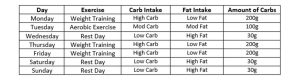
Building muscle requires adequate carbohydrates to fuel workouts and support recovery. Increase the frequency of your high-carb days, especially around intense resistance training sessions. For those aiming to shed pounds, focus on creating a moderate calorie deficit while preserving muscle mass. Incorporate more low-carb days, but don’t eliminate high-carb days entirely – they’re crucial for maintaining metabolism and supporting workouts.
Why tracking your metabolism beats counting calories
While carb cycling may have some potential advantages for athletic performance or weight loss, whether you should try it or not depends on your individual goals, preferences, and health status. The key lies in listening to your body’s signals and adjusting the approach according to your body’s needs, rather than adhering rigidly to a one-size-fits-all carb cycling regimen. A carb cycling diet generally alternates days of high carbohydrate intake with days of low and moderate carb intake. Here, Pritzker breaks down three sample days so you can see the difference.
Athletic Performance
This typically means alternating between high and low-carb days to provide your body fuel when it needs it. Carb cycling can be customized to align with individual fitness, weight loss, or muscle-building goals by adjusting the frequency and intensity of high and low-carb days. Here’s how carb cycling can be tailored to meet different objectives. In contrast, lower carb days involve intentionally reducing carbohydrate intake and usually consist of a higher fat intake to compensate for the reduced calories from carbohydrates. The ketogenic diet and the carb cycling diet may seem similar as they are both dietary approaches that consist of manipulating carbohydrate intake. However, they do have some key differences in terms of macronutrient distribution, philosophy, and practice.
Go Beyond Glucose Data with Nutrisense
That allowed me to keep training hard, since I felt like my body was recovering well. This was inconvenient for me, since I wasn’t intentionally trying to cut calories, and I wanted to make sure I was eating enough. It did help me understand, though, why people sometimes find low-carb or keto to be effective for weight loss. In comparison, on low-carb days the goal was 20% of my daily calories from carbs (about 100 grams of total carbs a day), 30% from protein and 50% from fat. Depending on your goals, you may need to increase fats slightly on https://megagrass.com/community/question-and-answer/forums/4133-general-questions/topics/2805151-mad-muscles-for-fat-loss-anyone-tried-it your low-carb days to help with your overall satiety. Fats typically range from 25-30% of your total calorie intake.
When life gets messy, most coaching plans fall apart.
However, it also says that carb intake should be personalized and that a “periodized” approach (another term for carb cycling) may be best. There is no one “right” way to carb cycle, and you must take into consideration your goals, age, gender, height, weight, body fat percentage and workout program. What we have found to work best is to lower total carbs to approximately 50 grams on the low-carb days, and increase to around 150 grams on the high-carbs days. Protein stays relatively constant on all days, which will help with satiety as well as muscle preservation. Carbs and fat work in opposition to each other – when carbs are low, fat is high, as well as the reverse.


